Dear WashU Faculty,
Over the past four years—informed by the ideas of more than 150 faculty and staff colleagues –we have worked to identify shared strengths and aspirations across our undergraduate schools and to weave these into a university-wide framework for undergraduate education. Our goal has been not to add an extra layer of requirements for students (or faculty!) who are often spread thin, but rather to elevate and connect the exceptional work already happening across our schools into a coherent, distinctive, and deeply impactful academic experience for every WashU undergraduate student.
The framework (visualized below) that emerged from our iterative collaborations comprises:
- A small set of shared foundations that every WashU graduate should possess, including the capacities to communicate effectively, think creatively and drive innovation in their field, and build understanding through quantitative or computational fluency.
- A collection of curricular and co-curricular opportunities that cultivate integrative skills: becoming civically rooted and globally aware, developing the capacity to both lead and collaborate, and learning to engage constructively across complex differences, whether disciplinary, cultural, or ideological.
- A deliberate focus on helping students discover and articulate a coherent sense of purpose, to narrate who they are becoming and how they hope to matter in the world- from their first day on campus through the moment they walk across the graduation stage.
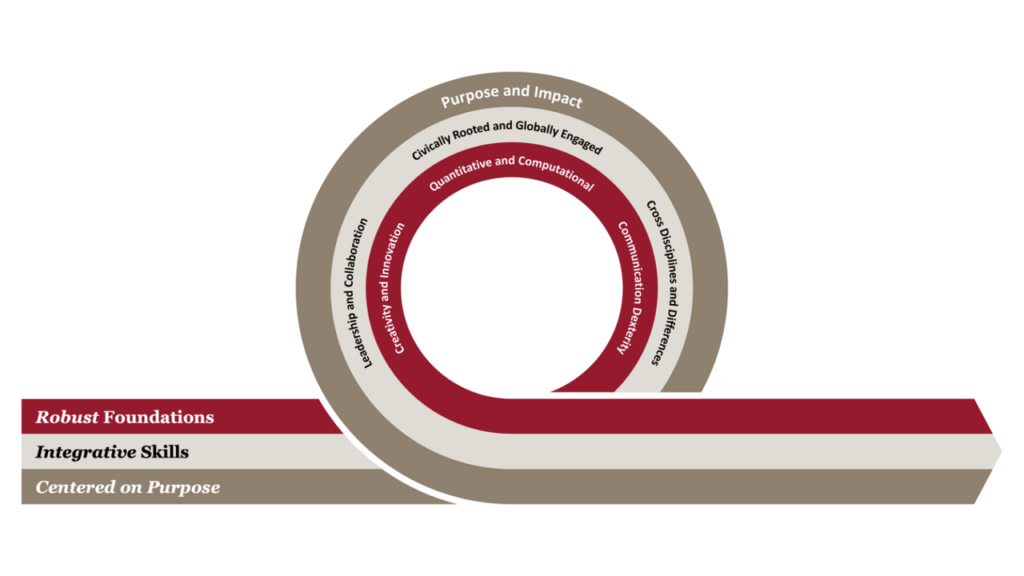
Our focus in developing this framework has been on alignment of school and university strategic priorities rather than invention, so you should recognize in it some ideas and language from ongoing work in your schools and across campus. There are, though, still opportunities for innovation in building out this framework in ways that respond to the emerging realities our students are coming from and into. For example, navigating the impacts of artificial intelligence on our students’ learning and their preparedness for their post-graduate life will require some reimagining of how we best support our students in using novel tools while also protecting and cultivating the human relationships and direct engagement with artifacts of scholarship and creative practice that make education not just effective, but fulfilling. We envision this framework in part as a response to AI in that the desire to foster students’ technological fluency is balanced by a deep commitment to supporting their authentic learning, their capacity to critically evaluate the context and implications of their actions, and their self-awareness. Towards that last end, we have been working with a series of university partners to build a more intentional model of reflective practice to provide structure for students’ exploration and development of their sense of purpose, a process that would draw on the richness of experiences inside and outside the classroom at WashU.
Our next steps will be to broaden our conversations with faculty and students beyond the representatives that have already contributed to the work to ensure that this framework genuinely serves our community well. In the new year, we will attend faculty meetings in each school, where we hope to share more, listen deeply, and learn from your perspectives.
Before those conversations, we would be grateful if you could let us know via this short survey:
- what you are already doing that may align with this emerging model (so that we may continue to highlight and connect existing efforts), and
- what questions you have about how we got here and where the work is headed next (to help us shape the upcoming school-based meetings).
Finally, and more importantly, as we approach the end of the term and this holiday season, we want to thank you for the care, creativity, and commitment you bring to our students every day. It is a privilege to do this work alongside you.
Warm regards,
Jen Smith
Vice Provost for Educational Initiatives
Professor, Earth, Environmental and Planetary Sciences (Arts & Sciences)
Peter Boumgarden
Assistant Vice Provost of Undergraduate Education
Koch Professor of Practice in Family Enterprise (Olin Business School)