Provided here is a step-by-step explanation of the academic integrity conduct process to help clarify expectations.
- Academic integrity reports may be brought by anyone at any time, even after a course has been concluded or a student has graduated. However, reporters are strongly encouraged to file an academic integrity report online in a timely manner, normally within five business days of discovery, so that the incident may be handled fairly and consistently across schools and departments. Teaching assistants, assistants in instruction, and proctors are expected to report instances of student misconduct to their supervising instructors.
- The report is reviewed by an Academic Integrity Coordinator (AIC) to determine whether there is enough information to move forward with the academic integrity process. If there is insufficient information, the AIC may choose to gather more information, including meeting with the parties and witnesses in an informal manner to obtain relevant information.
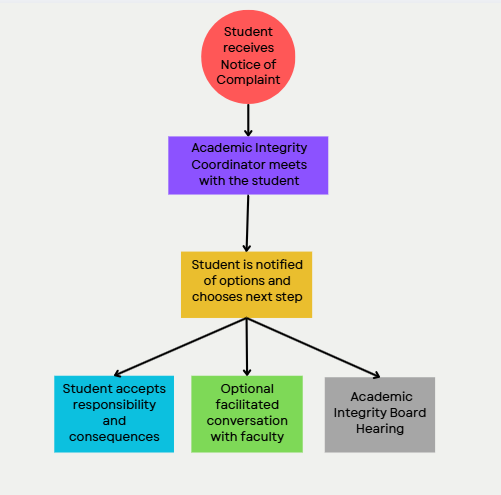
- The student who has been accused of the academic integrity violation will receive an email with a Notice of Complaint and a request to meet with an Academic Integrity Coordinator to discuss the allegation. This meeting is an opportunity for the Coordinator to get acquainted with the student, to explain the academic integrity process and answer questions, and to assist the student in responding to the allegation that was reported. Failure to attend a meeting with the AIC will not prevent the case moving forward in the academic integrity process.
- After the meeting the student will receive a letter via email outlining possible next steps. The responding student will choose to move forward with one of the following options, as stated in the Option Letter:
- Accepts responsibility for the violation and agrees to the proposed sanctions: If the student chooses to accept the responsibility for the violation, the process ends here.
- Requests to participate in a facilitated conversation with the reporting party: This conversation provides the reporting party with the opportunity to explain why the student’s actions led to an allegation of academic misconduct and the student the chance to provide context for their actions in a more informal environment than that of a hearing. As a result of this meeting, the allegation may be resolved with either the student accepting responsibility for the violation, the reporting party dismissing the complaint, or both parties progressing to a hearing panel with members from the Academic Integrity Board. *
- Requests a panel hearing with members of the Academic Integrity Board (2 faculty members and 1 student member). Non-response to the notification email after five business days will progress the case to a hearing panel.
- Additionally, when responding to an allegation of an academic integrity violation, a student may:
- Request a leave of absence from the university. The academic integrity matter must be resolved prior to re-enrollment. A notation will be placed on the student’s transcript indicating there is an unresolved academic integrity matter pending.
- Request to withdraw permanently from the university with a transcript notation that there is an unresolved academic integrity matter pending.
*Note: Although a student may request a facilitated conversation, the reporting party may decline to participate. In that circumstance, the case will be resolved via an AIB panel hearing.
- The Academic Integrity Board Panel Hearing:
- If the responding student chooses to move forward with an AIB panel hearing, three members of the Academic Integrity Board (AIB) will convene to hear the academic integrity case. The AIB panel hearing will be chaired by a Student Conduct Officer or an Academic Integrity Coordinator. The reporting party will be asked to share information and respond to questions. The student will be asked to share information and respond to questions. At the conclusion of the hearing, the Panel will determine whether the responding student is more likely than not responsible for the alleged academic integrity violation. If the Panel finds a violation, the Panel will assign sanctions. The sanctions assigned by the Board may be different than those stated in the Option Letter.
- The responding student and reporting party will be requested to provide witness names and contact information, support person name and contact information, documentation and evidence, relevant communication documents, a written statement, and other materials pertinent to the case five business days prior to the hearing. Please send all information to academicintegrity@wustl.edu.
- All parties involved in the hearing panel will receive the evidence packet three business days prior to the scheduled hearing panel.
- Please note that the student may bring a support person to an Academic Integrity hearing panel with the AI Board members. A support person is any one person chosen by a Respondent, Complainant, or Witness to accompany them at any meeting or interview throughout the student conduct procedure. A Support Person will serve at the student’s own expense and may include, for example, a friend, faculty member, advisor, or parent. The function and role of the Support Person is to provide support, advice, or assistance to the person requesting their presence. The Support Person shall not be permitted to actively participate in any part of the procedure and may not serve as a fact Witness or a party in the proceedings. Therefore, if the individual personally witnessed the events at issue or has other information relevant to the factual circumstances, they may not serve as the Support Person.
- Faculty always hold the authority to assign the grade for the assignment and the course that they deem appropriate.
- If you need accommodations, including translation services, please alert the Academic Integrity Coordinator as soon as possible.
- Appeal Process:
- If a student believes the Panel did not conduct a fair hearing and/or if a student believes the sanction imposed is excessive, they may seek an appeal within 14 calendar days of the original decision using the Academic Integrity Appeal Request Form. In cases in which the decision resulted in suspension or expulsion, the appellate officer will be the Vice Provost of Undergraduate Education or the Vice Provost for Graduate Education and International Affairs. For all other cases, the appellate officer will be the Chair of the Student Conduct Board. Appeals are governed by Section VI of the University Student Conduct Code.
- If a student files an appeal and the original decision and sanctions are upheld, the sanctions will take effect upon issuance of the appeal decision and will be served in full.
Updated July 2026